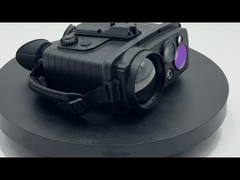
Brief: This video demonstrates the setup, operation, and key moments during typical use of the NVD3000 Lightweight Night Vision Infrared Telescope. You'll see how to switch between thermal imaging and visible light modes, utilize the laser ranging and satellite positioning features, and explore the guided search and fog penetration functions for effective field observation and surveillance.
Related Product Features:
Switch seamlessly between thermal imaging and visible light observation modes with one-key operation.
Integrated laser ranging provides precise distance measurement from 50m to 6km with human-eye safe wavelength.
Built-in satellite positioning and electronic compass offer accurate self-positioning and target location data.
Supports guided search functionality by entering target coordinates for efficient field operations.
Features fog penetration in visible light mode for clear observation in challenging weather conditions.
Offers digital zoom from 1x to 4x and customizable screen brightness, contrast, and image enhancement.
Designed with IP67 rating and operates in extreme temperatures from -40℃ to 55℃ for rugged outdoor use.
Weighs only 1.6kg with up to 10 hours of working time and 32G memory storage for extended field missions.
প্রশ্নোত্তর:
What are the key observation modes available on the NVD3000?
The NVD3000 features both thermal imaging and visible light observation modes that can be easily switched with one key. It also supports PIP (Picture-in-Picture) display and includes fog penetration functionality in visible light mode for enhanced clarity.
How accurate is the laser ranging and positioning capability?
The laser ranging function has a minimum range of 50m and maximum range of 6km with precision ≤2m. The positioning system offers ≤7m CEP precision, magnetic azimuth ≤0.5° RMS, and target positioning accuracy of ≤20m CEP at 2km distance.
What environmental conditions can the NVD3000 withstand?
The NVD3000 is built for rugged outdoor use with IP67 waterproof rating and operates in temperatures from -40℃ to 55℃. It weighs only 1.6kg and provides up to 10 hours of continuous operation, making it ideal for extended field missions.